
How interest rates affect silver is a transmission question: policy-rate expectations move nominal yields; inflation expectations change real yields; yields and the dollar alter silver’s opportunity cost. A 25-basis-point repricing can therefore pressure or support silver differently from the central-bank headline, especially when the move was already priced into markets.
The missing operational step is horizon comparison. You need to separate the expected move from the surprise, then check whether real yields, the dollar, forecast ranges, and timeframes confirm the same message. PRISM’s 48-hour OHLC forecasts make that comparison visible without turning a model output into a trade instruction.
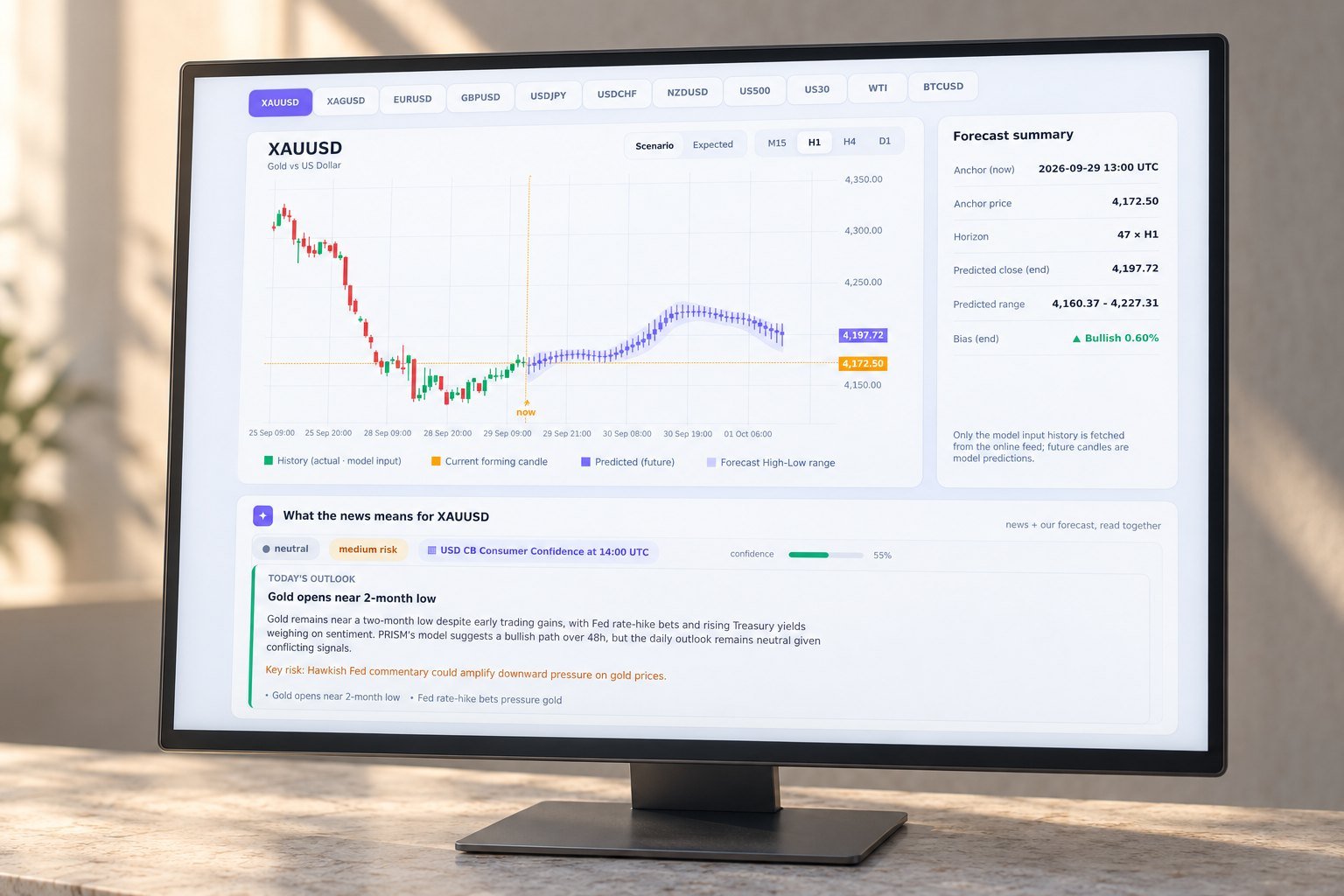
How do interest rates affect silver?
Interest rates affect silver through nominal yields, real yields, the dollar, and opportunity cost. A higher expected policy path usually lifts bond yields and can make a non-yielding metal less attractive. The effect becomes stronger when real yields rise and the dollar appreciates together.
- Policy-rate expectations change the path of nominal Treasury yields.
- Inflation expectations determine how much of that yield is real. Upstox defines the real rate as nominal interest minus inflation.
- Yield changes influence the dollar through relative returns and capital flows.
- A stronger dollar and higher real yields raise the opportunity cost of holding silver without a coupon.
- Industrial demand, risk sentiment, and positioning can offset or amplify the rate channel.
Readers asking about silver and bond yields should separate the nominal move from real yields and silver. A 10-basis-point rise in nominal yields does not carry the same message if inflation compensation rises by 15 basis points. In that case, the real yield can fall by 5 basis points.
The practical Fed hikes silver impact depends on the message inside the move. The World Gold Council argues that the market’s interpretation matters more than the yield change alone. ING also identifies higher yields and a stronger dollar as direct pressure points for precious metals.
How can you tell a priced-in move from a surprise?
A priced-in decision confirms existing expectations and often produces a smaller post-event repricing. A surprise creates new information, so nominal yields, real yields, the dollar, and forecast horizons should respond more clearly.
Use the standard basis-point convention: 100 basis points equal 1 percentage point. The table below is an illustrative event read, not a live central-bank call.
| Event setup | Measured repricing | Interpretation |
|---|---|---|
| Expected 25-basis-point hike | Policy rate rises 25 bp; the move was already priced; nominal yield rises 2 bp and real yield rises 1 bp | Headline confirmation with limited new information |
| Unexpected 25-basis-point hike | Markets priced no hike; nominal yield rises 18 bp, real yield rises 11 bp, and the dollar gains 0.6% | New information increases opportunity cost and should alter near-term forecasts |
The second case matters because the rate headline is only the first event. If inflation expectations rise enough to offset the nominal yield increase, silver may react differently than the headline suggests. The World Gold Council’s framework is useful here: inspect the composition of the move, not only its direction.
Which forecast horizon should change first?
M15 should register the first short-horizon change, H1 should test whether it persists, and H4 and D1 should show whether the event has become a broader regime signal. PRISM re-anchors every 15 minutes across M15, H1, H4, and D1.
- Compare the pre-event anchor with the next 15-minute refresh. Failure mode: re-anchoring lag, triggered when a headline arrives just after the refresh.
- Check whether M15 and H1 move together. Failure mode: headline-only overreaction, triggered when the median path shifts but the forecast range does not widen.
- Compare H4 and D1 with the shorter horizons. Failure mode: horizon conflation, triggered when a short burst is treated as a 48-hour signal.
- Inspect forecast highs and lows separately from the expected close. Failure mode: median-path anchoring, triggered when the range expands but the midpoint appears stable.
This is why a forecast can disagree across horizons without being inconsistent. M15 may price the first dollar response, while H4 waits for real-yield confirmation. D1 may remain unchanged until the market decides whether the policy message affects growth, inflation, or both.
How does PRISM read a silver-rate event?
In an anonymized XAUUSD/XAGUSD event read, M15 changed first after one 15-minute re-anchor. H1 followed on confirmation, while H4 and D1 initially retained their prior shape. The XAGUSD forecast high-low band widened on M15 and H1, showing greater short-horizon uncertainty rather than a simple directional signal.
| Horizon | First observed change | Range behavior | Reading |
|---|---|---|---|
| M15 | Changed on the first refresh | High-low range widened | Initial reaction to the rate headline and dollar move |
| H1 | Changed after confirmation | Range remained wider | Short-term response had persistence |
| H4 | Lagged M15 and H1 | Limited immediate expansion | Real-yield confirmation was not yet complete |
| D1 | Changed last or held shape | No immediate structural break | The event had not yet become a full-horizon regime signal |
The hourly AI briefing separated the rate headline from the market response. It treated the policy announcement as the catalyst, then checked whether yields and the dollar confirmed it. That distinction prevents a headline from being mistaken for a complete explanation of silver’s move.

What should you check before trusting the forecast?
Trust the signal more when direction, range width, real yields, and the dollar agree across horizons. Treat a 62% directional probability as a model estimate, not a 62% return or a certainty.
- Check whether nominal and real yields moved together.
- Check whether the dollar confirms the opportunity-cost signal.
- Check whether forecast highs and lows widened, not only whether the midpoint moved.
- Check whether M15, H1, H4, and D1 agree or show a clear lag.
- Use the hourly briefing to separate the headline catalyst from the second-order market response.
The main failure mode is headline-only confirmation. It triggers when a rate statement sounds hawkish, but real yields and the dollar do not confirm the move. A second failure mode is range blindness—the expected close looks stable while forecast highs and lows expand sharply.
PRISM covers 11 markets with 48-hour OHLC forecasts across four timeframes. You can audit the result manually, connect it to an MT5 indicator, or pull the forecast through the REST API. For the neighboring gold-specific question, continue with Gold price prediction after applying the same yield-and-dollar framework.
What should you know about rate effects on silver?
Does a rate hike always hurt silver?
No. If inflation expectations rise faster than nominal yields, real yields can fall. A weaker dollar, stronger industrial demand, or a loss of confidence in policy can also offset the usual rate pressure.
Why watch real yields instead of nominal yields?
Real yields approximate the return left after inflation. They therefore measure the opportunity cost of holding a non-yielding metal more directly than nominal yields alone.
How often does PRISM refresh the anchor?
PRISM re-anchors every 15 minutes. Its hourly AI briefing then reads market news against each forecast horizon, helping you distinguish a headline reaction from a wider model change.
How should you use this rate signal?
Use the rate signal as a forecast-reading framework, not as financial advice. Separate expected from surprise, compare M15 through D1, inspect the high-low ranges, and verify the real-yield and dollar response. Forecasts are model output, and their reliability falls when the market response conflicts across horizons.
Apply the method to live 48-hour OHLC views with the Gold and silver price forecast →