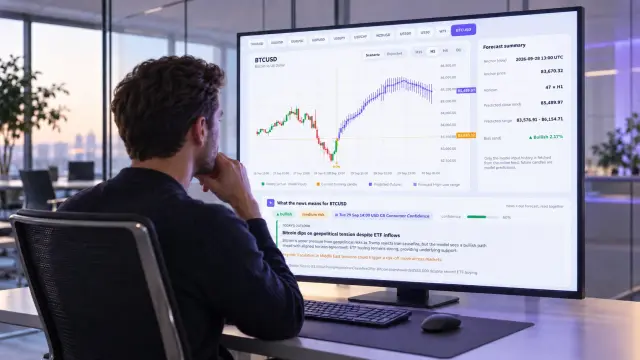
Forex prediction model validation starts with one question: can you reconstruct what the vendor predicted, when it predicted it, and what happened afterward? A polished dashboard is not evidence by itself. You need a repeatable record of forecasts, outcomes, inputs, versions, and exceptions.
The practical angle is simple. Treat the vendor as an external model owner, then test the complete forecast process across backtests and live observations. PRISM Forecasting produces 48-hour OHLC candle forecasts across 11 markets and 4 timeframes. That makes timestamp discipline, calibration, and drift more useful than a single headline hit rate.

Start with the vendor evidence, not the score
The Federal Reserve’s April 17, 2026 Supervisory Guidance on Model Risk Management makes the buyer’s task clear. A third-party model product still needs validation by the organization that uses it. You should understand its conceptual soundness, design, development data, and measured performance. Vendor documentation supports that work. It does not replace it.
Ask the vendor to define every number in the output. A 68% value might represent an event probability, a directional classification score, or an internal confidence measure. Those meanings are not interchangeable. Ask which event is being measured, which horizon applies, and how the value was calibrated against outcomes.
Separate design soundness from performance
Conceptual soundness concerns the forecast target and the logic connecting inputs to outputs. For an OHLC forecast, that means clarifying whether the model estimates a candle range, individual open, high, low, and close values, or probabilities around defined thresholds. You also need the market, timeframe, forecast horizon, and timestamp convention.
Development data deserves the same attention. Request the history period, data vendors, cleaning rules, corporate-action treatment where relevant, missing-bar handling, and feature cutoff. A backtest can look strong if information becomes available after the forecast timestamp. Your review should prove that the model only used information available at the time.
- Record the exact forecast timestamp and the market-data timestamp used for each prediction.
- Separate development, tuning, validation, and final out-of-sample periods.
- Report results by market and timeframe, not only as one blended percentage.
- Show spread assumptions in pips and define whether transaction costs affect the test.
- Keep failed requests, stale inputs, missing candles, and delayed updates in the review set.
Forex prediction model validation needs rolling evidence
A single historical split is too narrow for forex forecast accuracy testing. Use rolling out-of-sample evaluation instead. Train or tune on an earlier window, forecast the next window, advance the cutoff, and repeat. This exposes performance across different volatility, spread, and trend conditions without allowing later information into earlier decisions.
Evaluate the forecast at the same horizons your process will use. PRISM re-anchors its 48-hour OHLC forecasts every 15 minutes. The four available timeframes are M15, H1, H4, and D1. A useful review therefore checks whether the forecast remains coherent as the anchor moves, rather than treating one daily snapshot as the whole product.
Test calibration before ranking hit rates
Calibration asks whether predicted probabilities match observed frequencies. If forecasts assigned 70% probability to an event across 100 comparable cases, roughly 70 events should occur. That does not mean every sample will land exactly at 70. It means the relationship should be stable enough to measure with confidence intervals and sample counts.
Also separate forecast error from trade outcome. A predicted close can be directionally useful while missing the high-low range. A favorable trade result can occur despite a poor price forecast. Record OHLC error, directional accuracy, interval coverage, calibration, and drawdown separately. Do not compress those measures into one vendor score.
For PRISM, historical forecast-versus-outcome records should show the original anchor, the forecast horizon, each predicted OHLC value, the realized candle, and the comparison timestamp. Request enough history to reproduce the reported result. Then segment it by the 11 supported markets and by M15, H1, H4, and D1.

See also: Calibrated confidence trading model
Monitor behavior after the forecast goes live
Validation ends only when you stop measuring. Set a review cadence for rolling performance, calibration, missing data, latency, and distribution changes. Drift monitoring should compare recent observations with the reference period used for validation. Use fixed windows, such as 30, 90, and 180 days, so changes do not hide inside an annual average.
The Federal Reserve guidance also points to recalibration or redevelopment when performance deviates materially from expectations. Define that trigger before deployment. A trigger might combine a calibration breakdown, a sustained rise in OHLC error, or an outage rate above an agreed threshold. Document who reviews the result and what evidence supports the next action.
Trace versions, data, and incidents
Model versioning should let you identify the exact production artifact behind every forecast. Keep the version identifier, release time, changed inputs, changed targets, and validation window. Data lineage should connect each output to its source feed, transformation steps, missing-value treatment, and timestamp. Without that chain, an unusual result is difficult to investigate.
Incident handling needs an operational path. Define what happens when a market feed is late, a forecast is duplicated, an API response is incomplete, or the MT5 indicator displays an outdated value. Preserve the raw request and response, mark the affected forecasts, notify the right owner, and record the resolution. A clean incident log is part of model evidence.
The Financial Stability Board’s June 10, 2026 consultation report adds a wider governance lens. Its proposed practices span organization-wide oversight, the AI development and deployment lifecycle, cyber and ICT risks, and third-party dependencies. The final report is expected in October 2026. Use that framework to expand your review beyond predictive scores and into ownership, access, resilience, and supplier concentration.
For PRISM customers, the live forecast view is useful for observing the current 15-minute re-anchoring cycle. The MT5 indicator and REST API provide different operating paths, so test each path you plan to use. Each forecast should remain tied to its market, timeframe, anchor time, 48-hour horizon, OHLC values, probability or confidence fields, and model version.
See also: News impact on forex forecast
FAQ: practical questions for a vendor review
What is the first question to ask an AI forex vendor?
Ask whether the vendor can provide immutable forecast-versus-outcome records. You need the original timestamp, horizon, timeframe, predicted values, realized values, and model version. Without those fields, later accuracy claims are difficult to reproduce.
How much history is enough for forex forecast accuracy testing?
There is no universal number. Require enough observations for each market and timeframe to measure calibration and error with useful uncertainty bounds. A blended 11-market result can hide weak performance in one pair or one timeframe.
What does AI forex model validation cover?
It covers the forecast concept, development data, test design, output meaning, calibration, live monitoring, version control, data lineage, and incident handling. It should also identify where the vendor’s evidence stops and where your own use-case testing begins.
How should you handle vendor model risk?
Treat vendor model risk as an ongoing control problem. Assign an owner, preserve evidence, monitor deviations, and define escalation steps. A vendor forecast is model output, not financial advice, and it does not remove the need for your own trade sizing and decision process.
Use validation to size trust, not trades
Good forex prediction model validation gives you a bounded view of what the forecast measures and where it stops being reliable. Review rolling out-of-sample results, calibration, drift, versions, lineage, and incidents before you connect production workflows. Then review them again as conditions change. Read the PRISM forecasting model and its validation context before deciding how its 48-hour outputs fit your process. Forecasts are model output, not financial advice. Use the evidence to size trust, not to assume profit. →