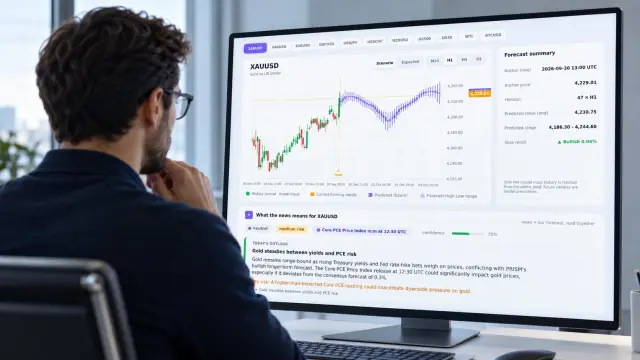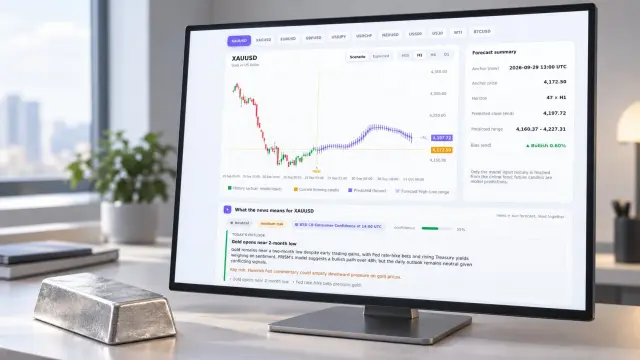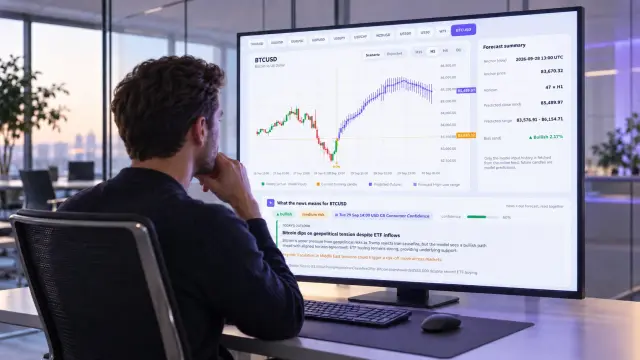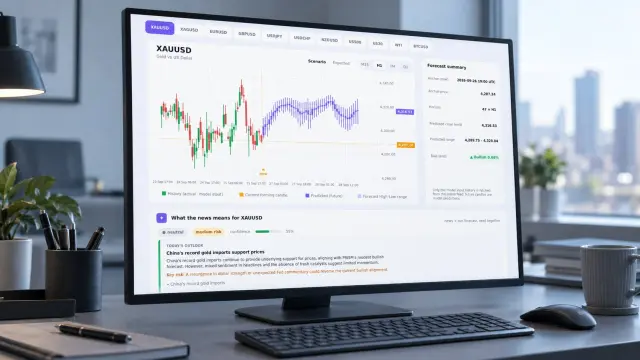
A forex prediction API is fit for production only when its payload makes candle state, anchor time, horizon, uncertainty, and refresh behavior explicit. Compare those fields before price or coverage. Then poll 100 responses to detect duplicate anchors, stale timestamps, missing candles, slow tails, and schema errors before your users depend on the feed.
That contract-first angle matters because a readable forecast can still be operationally wrong. PRISM Forecasting provides 48-hour OHLC forecasts across 11 markets and M15, H1, H4, and D1. The buying question is whether your consumer preserves what each candle means.

What must a forex prediction API payload prove?
A usable forecast payload must identify the symbol, timeframe, UTC anchor, horizon, candle kind, OHLC values, direction probability, and sigma. If one field is implicit, your chart or downstream model can assign the wrong meaning to a valid number.
PRISM's REST output is a useful reference because each forecast is tied to a candle interval and re-anchors with new quarter-hour data. Compare the payload with the live forecast and verify that the consumer preserves forming and future records separately.
| Field | Forming candle | Future candle |
|---|---|---|
| symbol and timeframe | EURUSD, M15 | EURUSD, M15 |
| anchor_utc and horizon_hours | 2026-09-19T14:15:00Z, 12 | 2026-09-19T14:15:00Z, 12 |
| kind and OHLC | forming; 1.08120, 1.08210, 1.08080, 1.08170 | future; 1.08170, 1.08300, 1.08090, 1.08240 |
| dir_prob and sigma | 0.58, or 58%; 0.0014 price units | 0.61, or 61%; 0.0021 price units |
The values above are illustrative. A forming candle contains partial market observations, so its close can change before the interval ends. A future candle contains model output for a later interval. Your schema should make kind explicit and should not treat a forming close as final.
How should you compare payment, limits, and delivery?
Compare authentication, billing, cache policy, refresh policy, transport formats, and availability as one contract. A low request price does not compensate for unclear refresh behavior or undocumented schema changes.
Kronos Quant Signal documents an x402 payment model with no API keys and no signup. Its requests use USDC on Solana or Base, with prices from $0.001 to $0.05 per request. The documentation also separates limits for cached predictions from limits for refreshed predictions. That distinction matters for polling budgets.
FXMacroData shows why field names deserve the same review as pricing. Its changelog moved forecast values into a nested predictions[] structure, made announcement_id the grouping key, and replaced the interest_rates slug with policy_rate. A parser that silently accepts the old shape can return incomplete forecasts without a transport error.
OANDA's developer resources illustrate the conventional alternative: REST delivery in JSON, XML, and CSV, more than 38,000 currency pairs, redundant servers, and a seven-day trial. Those details help you assess format compatibility and operational fallback, even when your target is an AI forex API.
| Decision area | What to require | Use when |
|---|---|---|
| Authentication and billing | Document API-key behavior or x402 payment headers, settlement network, and per-request price | You need predictable procurement or pay-per-call usage |
| Cache and refresh | Separate limits, timestamps, and definitions for cached versus refreshed predictions | You poll dashboards, research jobs, or alerting services |
| Payload shape | Stable required fields, versioning, nested-array rules, and migration notices | You store forex prediction JSON for later analysis |
| Delivery and resilience | Supported formats, timeout behavior, retry guidance, and availability design | You serve live users or maintain a research pipeline |
See also: Does Forex Prediction Indicator Repaint?
How do you test freshness and candle alignment?
Run a 100-response integration test against the exact symbol and timeframe your product will use. Record request time, response time, anchor_utc, candle kind, field presence, and status code for every response.
- Send 100 consecutive requests and record latency in milliseconds. Failure mode: a timeout or retry loop hides an unreliable p95 response time.
- Count duplicate anchor_utc values separately for cached and refreshed requests. Failure mode: duplicate anchors are misread as new forecasts when the cache policy is not understood.
- Compare each anchor with the latest expected M15, H1, H4, or D1 boundary in UTC. Failure mode: stale-anchor acceptance displays an older forecast as current.
- Validate required fields, numeric ranges, and candle count. Treat missing candles, dir_prob outside 0 to 1, negative sigma, and malformed timestamps as schema errors.
- Measure p95 latency and schema errors across all 100 responses. A practical gate is zero schema errors and a p95 that stays inside your written service target.
- Check that a forming candle remains mutable and that a future candle remains classified as future. Failure mode: forming-bar finalization writes a provisional close into permanent history.
Use RFC 3339 UTC timestamps, such as 2026-09-19T14:15:00Z, and validate them before storage. Record sigma's unit and scale beside the field definition. A 0.0021 value is not comparable across providers unless both APIs define the same price unit.

What breaks if you trust the wrong candle or anchor?
Two failures cause most prediction-payload defects: forming-bar finalization and stale-anchor acceptance. Both begin when your consumer treats time or candle state as presentation detail instead of contract data.
Forming-bar finalization
If your consumer saves the current M15 close as final at 14:22 UTC, the value can change before 14:30 UTC. Downstream charts, alerts, and performance reports then contain a false completed candle. Keep forming records updateable and finalize only after the interval boundary.
Stale-anchor acceptance
If a refreshed request returns an anchor from an earlier interval and your code accepts it, the chart appears current while showing old model output. Trigger a freshness error when the returned anchor is older than the latest expected boundary for the requested timeframe.
Which forex prediction API checklist belongs in procurement?
Ask for written answers to these questions before you compare request prices. The checklist should describe behavior under normal polling, cache hits, refreshes, schema changes, and delayed responses.
- Does every record expose symbol, timeframe, anchor_utc, horizon_hours, candle kind, OHLC, dir_prob, and sigma?
- Are forming and future candles distinct in both the payload and the documentation?
- Which timestamp standard applies, and what tolerance defines a stale response?
- Are cached and refreshed prediction limits separate, and can your client identify the difference?
- What happens when a candle is missing, a field is renamed, or an array becomes nested under predictions[]?
- Does the provider publish migration notices for grouping keys such as announcement_id and slugs such as policy_rate?
- Can you run 100 consecutive requests and obtain enough telemetry to calculate duplicate anchors, stale timestamps, missing candles, p95 latency, and schema errors?
See also: MT5 AI Forex Prediction: What Build 6180 Adds
FAQ: choosing a forex prediction API
What is the difference between a forming and future candle?
A forming candle contains partial observations and may change before close. A future candle is model output for a later interval. Store and display them with different state rules.
Is an x402 model better than API-key access?
Neither is universally better. x402 can support no-key, pay-per-request access from $0.001 to $0.05. API keys may fit teams that require account controls, usage reports, or conventional procurement.
How many responses should you test?
Use 100 consecutive responses for a practical first gate. That sample exposes duplicate anchors, stale timestamps, missing candles, p95 latency, and schema errors under repeated polling.
What does sigma tell you?
Sigma expresses model uncertainty on the provider's stated scale. Do not compare sigma values across APIs until their units, horizon, and calibration rules match.
How should you choose a forex prediction API?
Choose the forex prediction API that gives your team an explicit data contract, visible refresh behavior, stable timestamps, and testable uncertainty fields. PRISM Forecasting provides 48-hour OHLC forecasts across 11 markets and four timeframes through a REST API. Forecasts are model output, not financial advice, and they do not promise profit. Review the PRISM market forecast API and test the payload before production →