Most AI forex accuracy claims trace back to one thing: a model tuned once on historical data, then graded on that same data. That's the mechanic behind forex forecast backtest overfitting — the reason a demo showing 78% directional accuracy can fall apart in week one of live trading. The number isn't fake. It's just measuring the wrong thing: how well the model memorized the past, not how well it handles a future it has never seen.
Artificial Intelligence News reported in March 2026 that controlled demonstrations of AI currency-forecasting tools typically reflect historical data or optimized backtests — a different environment from live market volatility. The Neural Base's finance course defines the underlying failure more precisely: overfitting means fitting a model to noise, random patterns in historical data that never repeat. Put the two together and you get the real question behind any AI forex accuracy claims: was this number produced on data the model already learned from, or on data it had genuinely never touched?
What forex forecast backtest overfitting actually means
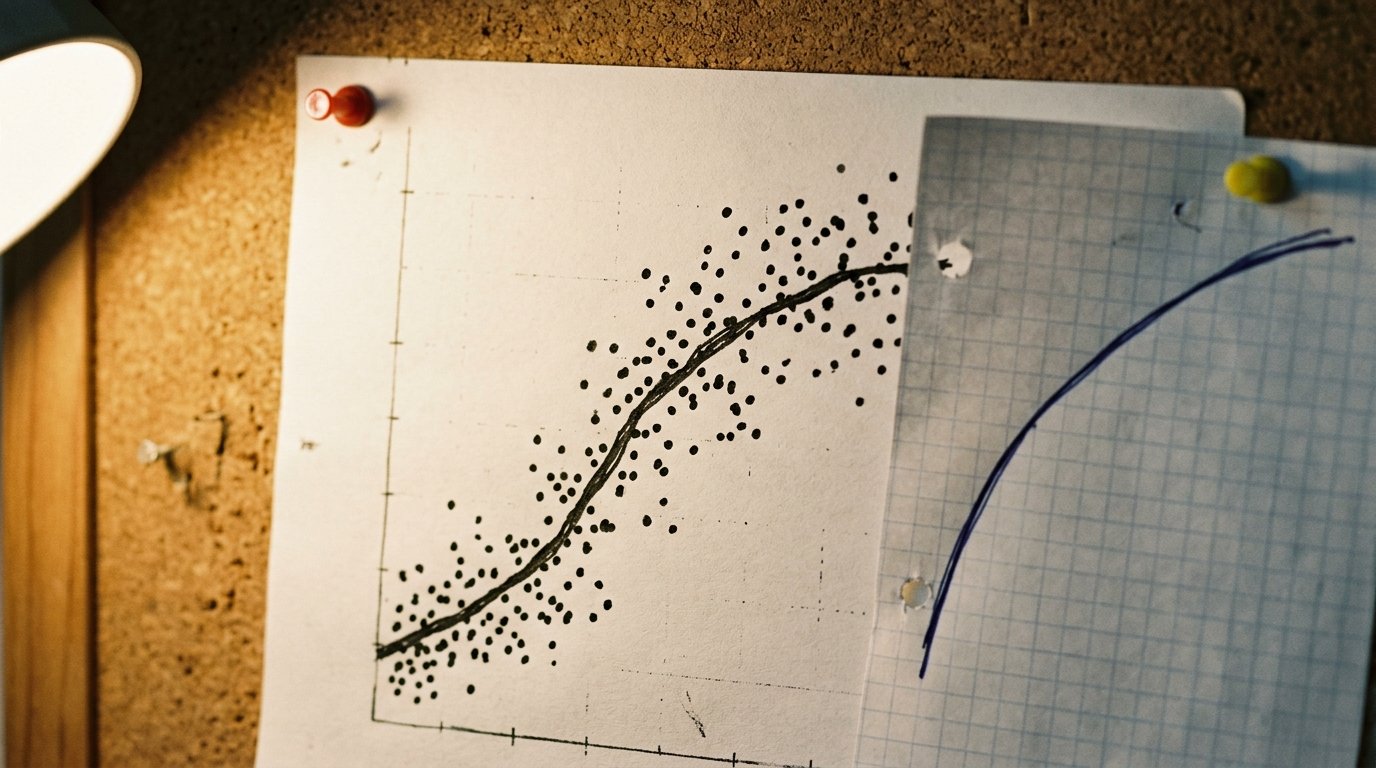
Overfitting isn't a vague warning — The Neural Base's course defines it precisely: a model fits noise, meaning it treats random historical patterns as if they were repeatable signal. In forex, that noise is constant. A pair spikes on one earnings surprise, one central bank leak, one thin-liquidity Friday close. Tune a model's weights, thresholds, or entry rules against ten years of that noise, and it will "learn" relationships that have no future. Test 1,000 rule variations against the same ten years of data, and roughly 50 will look statistically significant by chance alone, at a 5% significance threshold. None of those 50 predict anything real.
The more parameters a model tunes against one dataset, the higher the curve-fitting risk. A model with three inputs and two thresholds behaves differently than one with 40 tunable weights fit to the same historical window. Complexity isn't the problem by itself — complexity tuned once and never re-tested is.
Why AI forex accuracy claims inflate in live trading
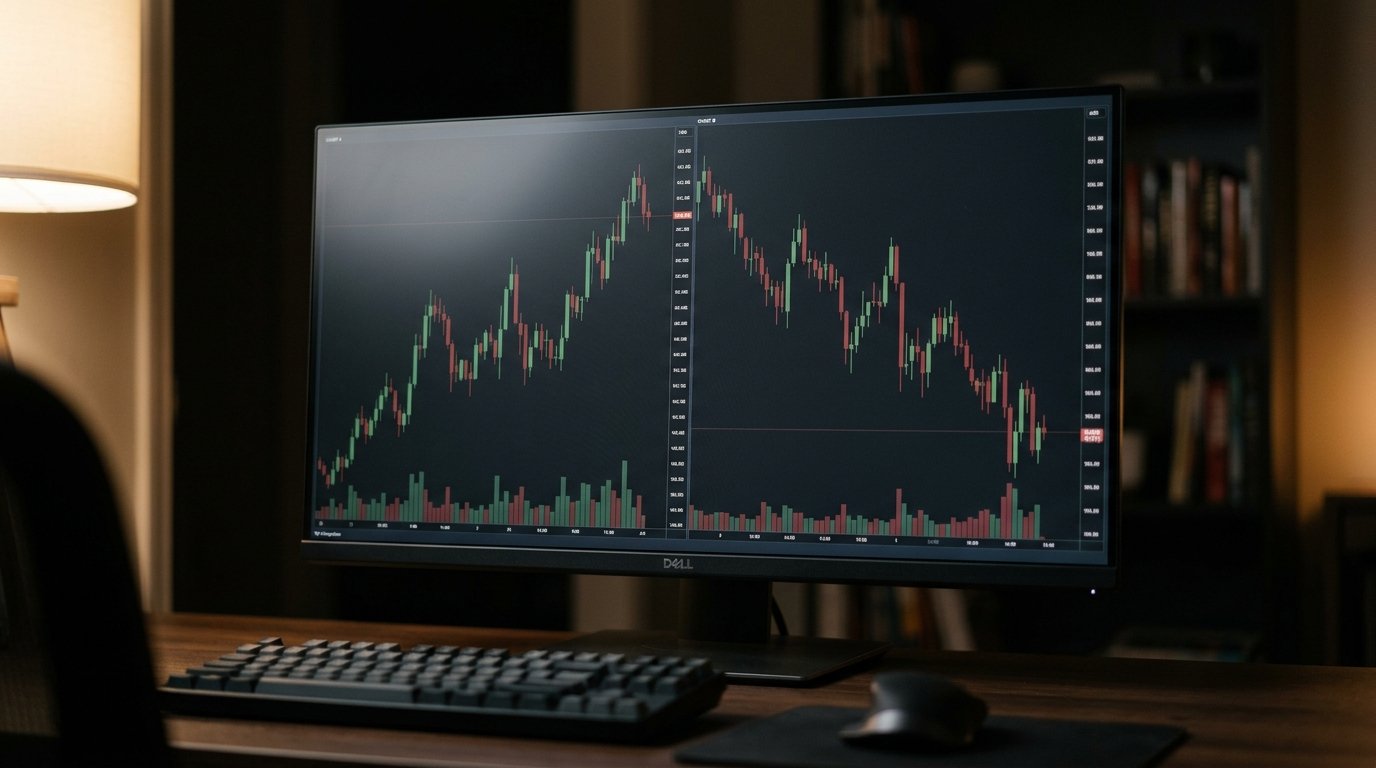
Artificial Intelligence News's March 2026 assessment of AI-powered currency forecasting tools makes the gap explicit: accuracy claims in controlled demonstrations usually come from historical data or optimized backtests, and that's a different environment than live trading, where latency, slippage, and spread widening all cut into results before a trade even closes.
The piece also flags a definitional problem worth repeating: "accuracy" itself is ambiguous. Directional accuracy — did the pair move up or down — is a different metric from magnitude accuracy, how far it moved, or timing accuracy, when it moved. A vendor can report the flattering one and stay technically honest while still leaving you with the wrong impression.
- Which definition is being reported — direction, magnitude, or timing
- Whether spread, slippage, and execution delay were modeled at all
- How many parameter combinations were tried before the published run was chosen
- Whether the test window covered a regime shift, or just one trending stretch
See also: Calibrated confidence trading model
Walk-forward validation forex models actually need
Walk-forward validation is the fix for both problems above. The rule is simple to state and hard to fake: judge a model only on data it never touched during tuning. Split history into an optimization window and a separate, untouched test window. Optimize parameters only inside the first window. Score performance only on the second. Then roll both windows forward and repeat. Out-of-sample forex testing means the test segment was never part of the fitting process — not a held-out slice of the same run relabeled as "unseen" after the fact.
- Optimize the model on one historical window only
- Freeze the parameters — no further tuning
- Score the model on the next, untouched window
- Roll both windows forward and repeat across the full history
- Treat the aggregate out-of-sample result, not the optimization-window result, as the realistic estimate
Skip this process, and a backtest report tells you how well the code was optimized — nothing about how the model behaves on a candle that hasn't formed yet. That distinction is the difference between a marketing number and a forecast you can size a trade against.
See also: Exchange rate forecast
How PRISM turns re-anchoring into out-of-sample forex testing
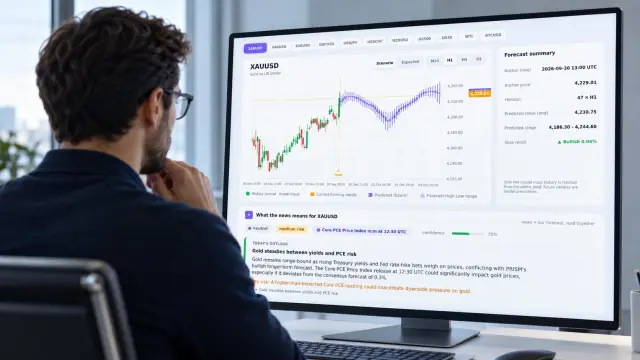
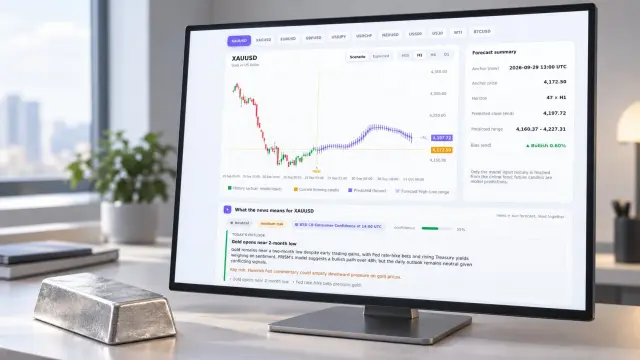
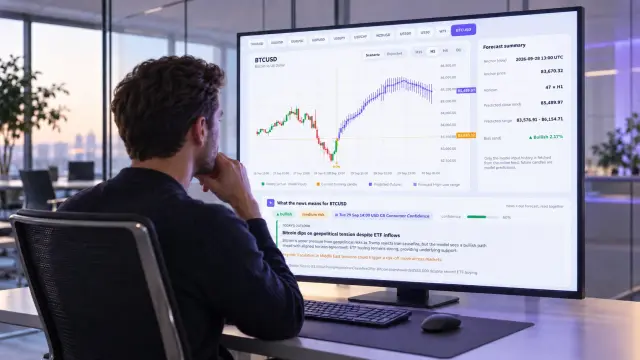
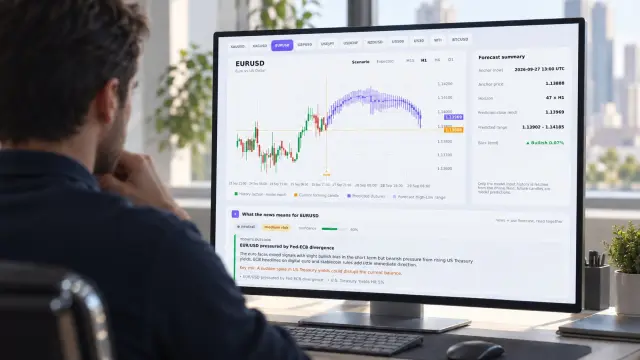
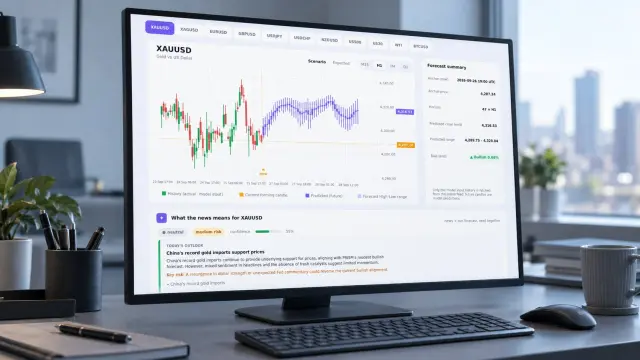
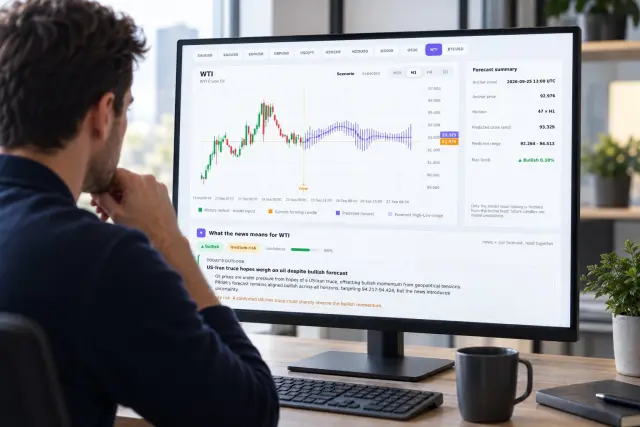
PRISM re-anchors its 48-hour OHLC candle forecasts every 15 minutes, across 11 markets and 4 timeframes — M15, H1, H4, and D1. Each re-anchor run is generated against the freshest closed candle, price action the model has never seen finalize, because it didn't exist at the previous run. That's structurally different from a backtest built once on years of history and marketed forever: instead of one static test, you get a new out-of-sample instance every 15 minutes, on every market and timeframe PRISM covers.
Forecasts publish live through the MT5 indicator and the REST API before the 48-hour horizon closes and the outcome is known. That means you can compare a specific forecast candle to the realized candle afterward, market by market, timeframe by timeframe — instead of trusting a vendor's backtest report. Forecasts are model output, not financial advice, and no accuracy figure, ours included, implies a certain outcome on the next candle.
FAQ: forex forecast backtest overfitting and walk-forward testing
Does a high backtested accuracy number mean anything?
It tells you the model can fit its own training data — nothing more. Before treating the number as predictive, ask which window was genuinely out-of-sample, and whether it was tested walk-forward rather than scored once on the data it learned from.
How is 15-minute re-anchoring different from a normal backtest?
A backtest runs once, on a fixed historical window, and gets published as a single number. Re-anchoring produces a new forecast on unseen data, on a fixed 15-minute cadence, indefinitely, across 11 markets and 4 timeframes — closer to continuous walk-forward testing than to one static report.
Can I verify a PRISM forecast myself?
Yes. Forecasts publish via the MT5 indicator and the API before the 48-hour window closes, so you can hold the forecast candle up against what actually happened rather than trusting a headline accuracy claim.
The bottom line
Forex forecast backtest overfitting isn't a reason to distrust every AI model — it's a reason to ask how a number was produced. A single optimized backtest, scored on the data it learned from, tells you almost nothing about live behavior. Walk-forward validation, out-of-sample testing, and forecasts you can check before the outcome is known are the difference. See how PRISM's forecasting model is built and re-anchored to understand what continuous out-of-sample testing looks like in practice, market by market, every 15 minutes.