Prediction markets let you buy and sell event contracts whose prices express a crowd's estimate of a future outcome. A Yes share at $0.67 implies roughly 67%, pays $1 if the event occurs, and pays $0 otherwise. The signal is useful, but rules, liquidity, fees, and settlement determine how much confidence it deserves.
The useful buyer's question is not only how prediction markets work. You also need to inspect venue structure, resolution sources, data quality, calibration, and failure modes before treating prediction market odds as evidence.
What are prediction markets, and how do they work?
Prediction markets let participants buy and sell positions tied to a clearly defined future outcome. The price changes as traders update their views, so the market produces a live estimate rather than a fixed bookmaker line.
What is an event contract?
An event contract is a position that pays according to a yes-or-no result. Ethereum.org gives the concrete example: a Yes share trading at $0.67 implies approximately a 67% market estimate, pays $1 if the event occurs, and pays $0 otherwise. CME Group describes the same $0.01-to-$0.99 price-to-likelihood scale.
A trader who believes the real chance is higher can buy. A trader who believes it is lower can sell or take the opposite side. Ethereum.org describes the structure as zero-sum apart from fees—one participant's gain comes from another participant's loss.
How does a market move from question to settlement?
The contract needs precise wording, a closing time, a resolution source, and a settlement process. The Polymarket Help Center explains that the market resolves against its stated rules, while blockchain venues may use an oracle to report the result on-chain.
- Read the question and resolution clause. Failure mode: vague wording creates disputes when the real-world event has several plausible interpretations.
- Check the order book or automated market maker before trading. Failure mode: thin liquidity makes the displayed price move sharply after a small order.
- Compare the bid, ask, fees, and available depth. Failure mode: a narrow headline probability can hide a wide effective spread.
- Verify the oracle or named source. Failure mode: a reliable forecast still becomes unusable if the settlement source is delayed, unavailable, or contested.
- Record the final result and payout rule. Failure mode: a market can resolve differently from your intuition if its written definition uses a specific timestamp, data feed, or threshold.
How should you read prediction market odds?
Prediction market odds are best treated as prices that imply a probability after you account for spread, fees, liquidity, and settlement risk. A 70% price does not mean the outcome must occur. It means participants currently price the contract near that level.
Calibration is the test that matters over many comparable contracts. If contracts priced near 70% resolve Yes close to 70% of the time, the market is reasonably calibrated in that range. One contract cannot establish calibration, and a price can be distorted by informed traders, forced exits, or an incomplete order book.
| What to inspect | Why it matters | Use when |
|---|---|---|
| Bid-ask spread | A 2-cent spread can materially change your entry and exit price. | You need a realistic breakeven estimate. |
| Depth and volume | Low depth makes the displayed odds more sensitive to individual orders. | You are comparing large and small venues. |
| Resolution rule | The wording determines what counts as Yes or No. | The event has multiple data sources or timestamps. |
| Settlement source | An oracle or named authority determines the final result. | You are comparing on-chain and centralized venues. |
| Historical data and API access | Trade history supports testing, calibration, and monitoring. | You want repeatable analysis rather than a single screen price. |
Order books match buyers and sellers at quoted prices. Automated market makers quote against a liquidity pool and adjust prices as inventory changes. Order books can show explicit depth and resting bids. Automated market makers can remain continuously available but may expose you to pool imbalance, price impact, and formula-specific behavior.
Centralized venues hold trading records and settle through their own systems. On-chain venues record trades publicly and may use smart contracts for token custody and payout. Ethereum.org highlights the auditability of public blockchain data, while also noting that every venue still depends on clear rules and a credible resolution process.
What are the main prediction market risks?
Prediction market risks come from trader behavior, market design, data quality, settlement disputes, and changing regulation. The probability displayed on screen is only one input into your decision.
- Loss concentration: Ethereum.org reports that about 69% of Polymarket users ended with a loss, while the top 1% captured 76.5% of profits.
- Liquidity risk: a thin market can show a price that is difficult to trade near, especially during fast news.
- Information asymmetry: participants with earlier or better information can move the market before others react.
- Manipulation risk: large orders, wash trading, or coordinated activity can make a market appear more accurate or active than it is.
- Resolution risk: unclear wording, disputed facts, or a contested oracle report can delay or change settlement.
- Behavioral risk: binary outcomes and rapid price changes can encourage oversized positions or repeated trading.
What is the current U.S. regulation position?
The CFTC's June 2026 proposal would amend Regulation 40.11 and add Appendix F, with a 90-day review framework for certain event contracts. It is a proposal, not universal approval of every contract or venue. Rules can differ by jurisdiction, contract type, and platform, so check eligibility and local requirements before trading.
How can PRISM add continuous-price context?
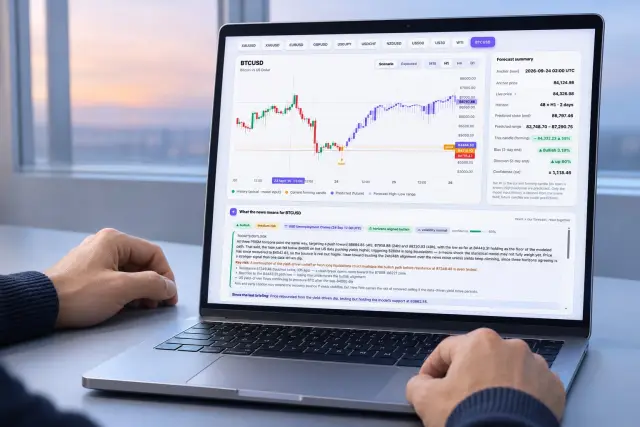
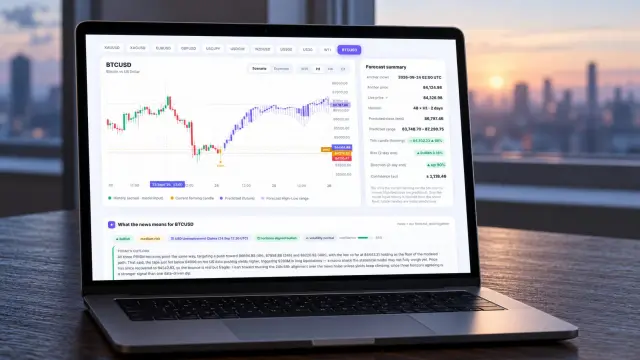
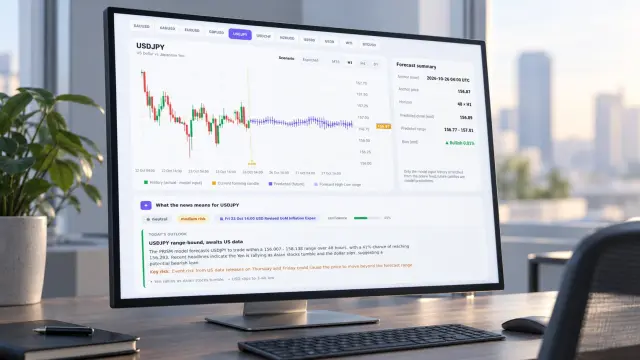
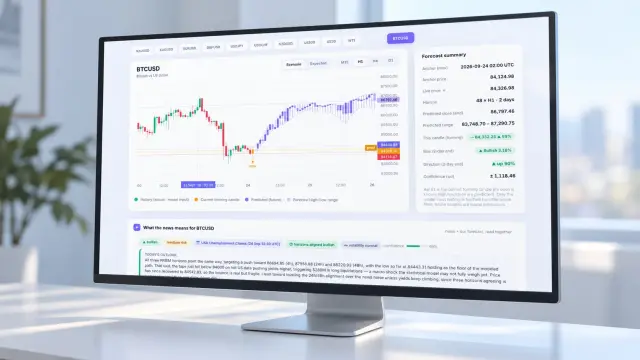
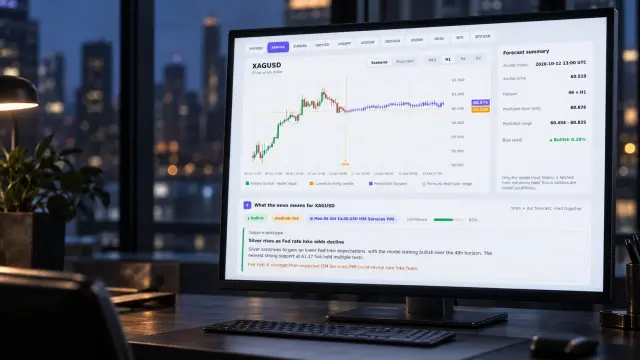
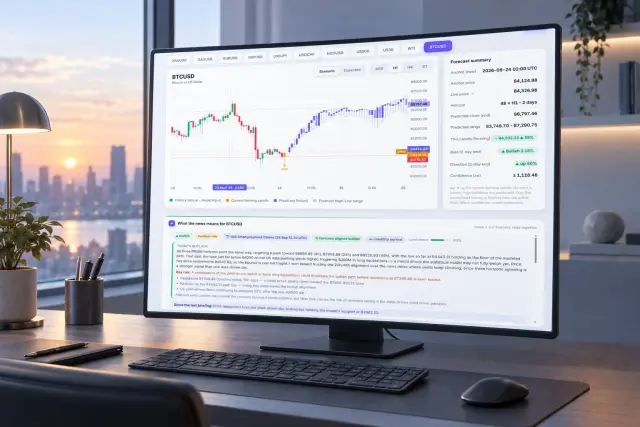
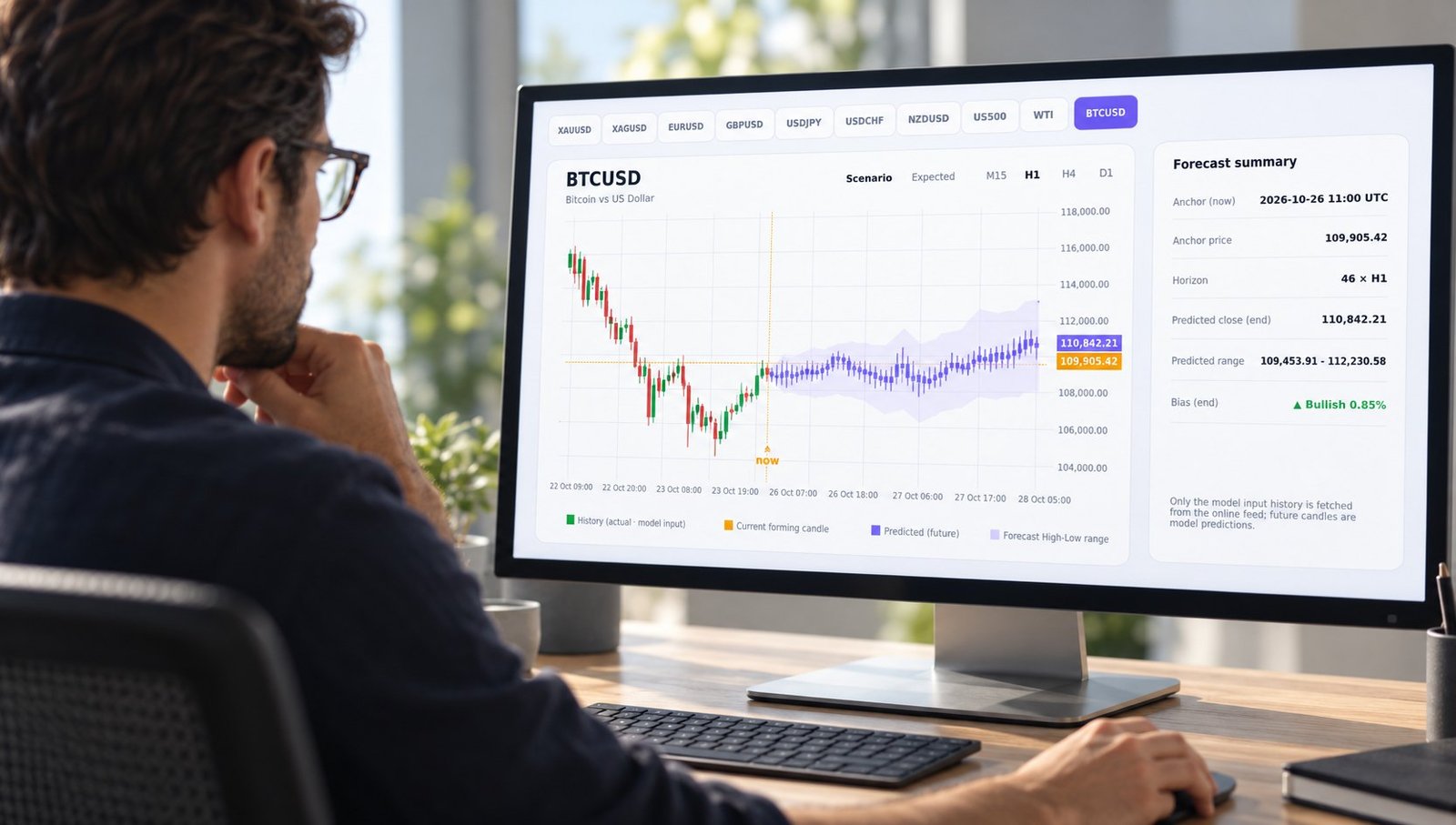
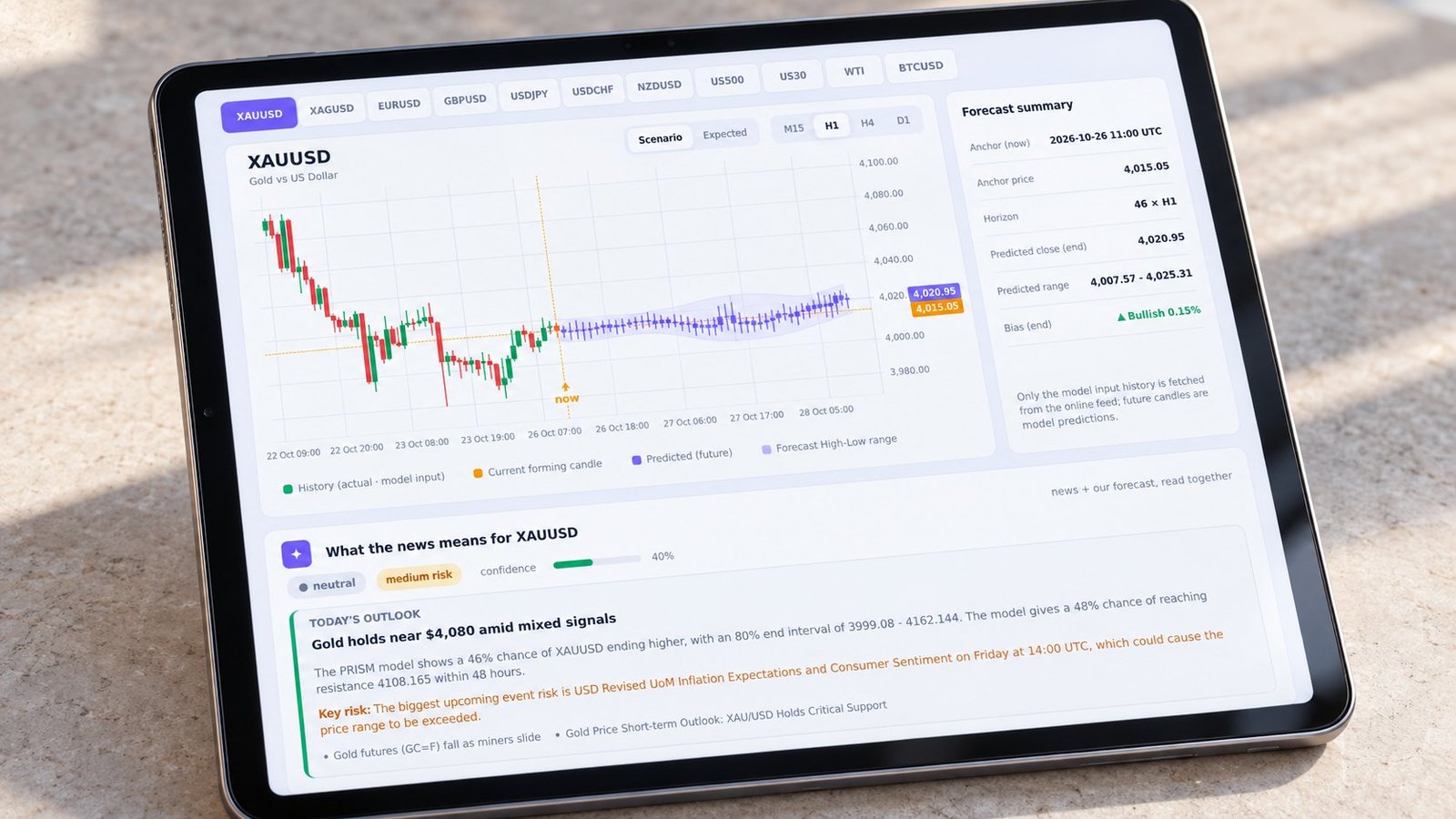
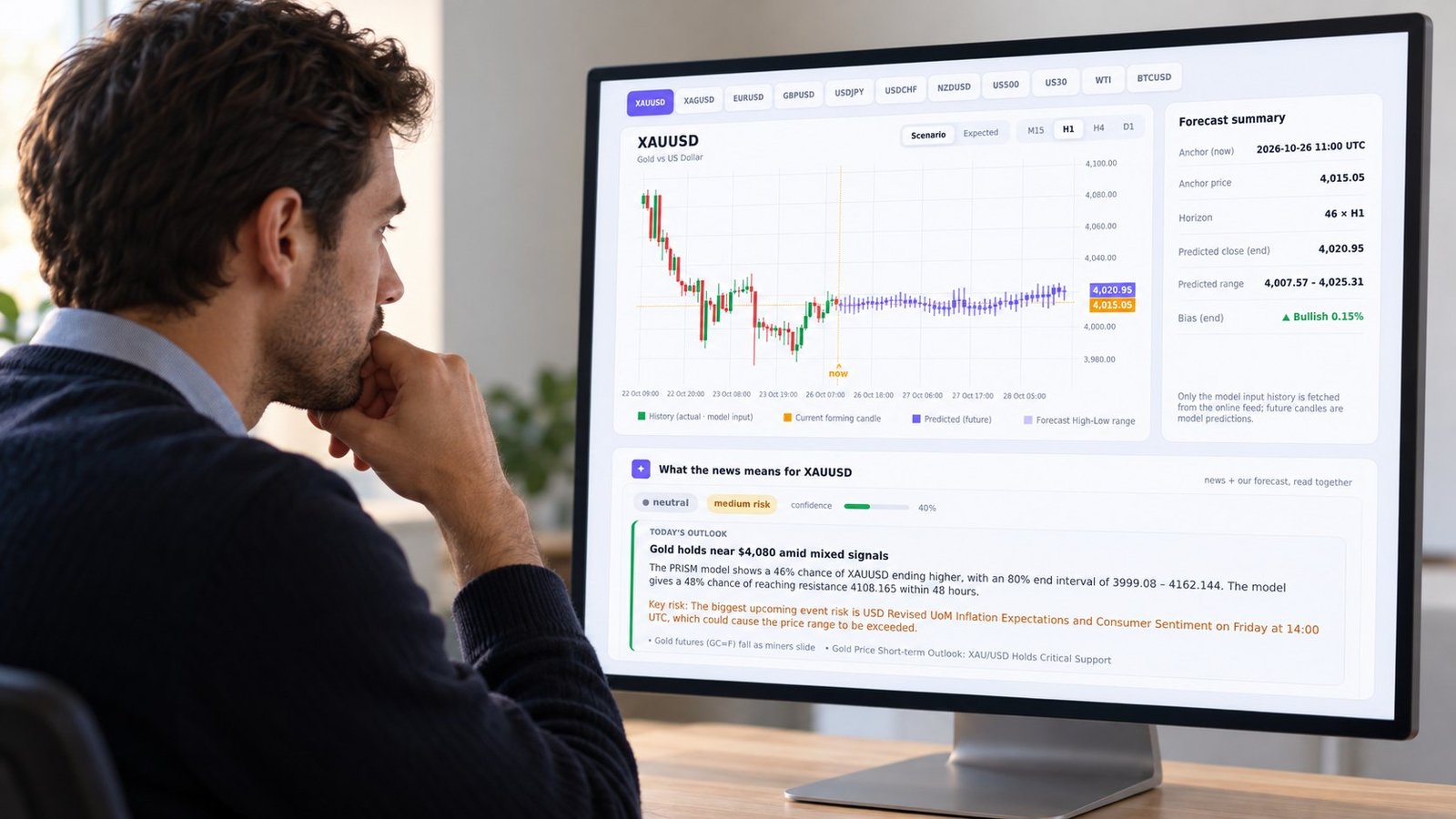
PRISM Forecasting adds a different measurement beside a binary event probability: a modeled path for continuous OHLC prices. PRISM produces 48-hour candle forecasts across 11 markets and four timeframes—M15, H1, H4, and D1—and re-anchors the forecast every 15 minutes.
That view can show whether price is trending, ranging, or approaching a modeled high-low area while an event contract shows only Yes or No odds. The two outputs are not interchangeable. PRISM does not convert an OHLC path into a contract probability or promise an outcome.
The hourly AI briefing reads public market news against each forecast and flags where news, direction, and modeled levels may agree or conflict. For programmatic monitoring, the PRISM REST API provides access to forecast output. If your question shifts toward continuous currency behavior, our exchange rate prediction analysis is the more relevant comparison.
Prediction markets FAQ
Is a 67% price the same as a 67% probability?
No. It is an implied market estimate. Spread, fees, liquidity, trader selection, and settlement uncertainty can all make the traded price differ from the underlying chance.
Can you sell before an event resolves?
Usually, yes, if another participant or the market mechanism provides a tradable exit. Your result then depends on the exit price, spread, fees, and remaining time rather than only on the final event outcome.
Are on-chain prediction markets more accurate?
Not automatically. On-chain records can improve auditability, but accuracy still depends on liquidity, incentives, contract wording, oracle design, and trader information.
Can a price forecast replace an event contract probability?
No. A price forecast measures a continuous path over a defined horizon. An event contract resolves a binary question under specified rules. Use them as separate measurements and examine where their assumptions differ.
A practical conclusion for prediction markets
The strongest workflow is simple: define the event, inspect the venue, calculate the effective price after spread and fees, verify the resolution source, and test calibration over comparable outcomes. Treat market price as evidence, not certainty. PRISM's live 48-hour forecast dashboard can add continuous-price and public-news context beside that binary probability. Forecasts are model output, not financial advice. →